


Start with where the cost lives
Before you consider any automation investment, it helps to understand where your warehouse costs are highest. Knowing which functions absorb the most labour or expense is where efficiency gains are found fastest.
In retail environments, picking typically accounts for the majority of labour cost. In e-commerce, the balance often shifts, the cost of packing labour can equal or exceed picking. Understanding your own split determines where to focus first.
It is also worth being honest about the scale of improvement you are trying to achieve. Going from 50–60 units per hour to 350–400 requires automation and capital investment. Going from 80 to 120 may not. The goal shapes the roadmap.
Quick wins before you spend anything
Significant improvements do not always require new systems. Before committing capital, review what is already within your control.
Re-mapping pick routes, adjusting team workflows, reviewing slotting strategies, and refreshing operator training can all make an immediate difference; less walking, fewer errors, improved throughput all at little or no cost.
Software can accelerate this quickly. PickIQ, our AI-powered picking optimisation software, reduces walking distance by up to 65% and improves picking productivity by 20–35%, without touching your warehouse layout or replacing your existing WMS. It connects to your current system, optimises the pick sequence, and hands it back. No capital expenditure, no rip and replace.
| 65% reduction in walking distance achievable with PickIQ, no capital expenditure required |
A roadmap, not a single project
For operations that need a more significant lift but are not ready for full automation, there is a staged approach. Each step builds on the last, delivers its own ROI, and lays the groundwork for what comes next.
Wearable scanning devices, such as ProGlove hand scanners are a strong first step. They are easy to deploy, quick to learn, and immediately improve picking speed and accuracy. They scale with your headcount and work from day one with most existing WMS platforms.
From there, the roadmap naturally progresses toward connected automation, conveyor-fed packing lines, automated labelling, sortation, and eventually robotics. The key is that none of these steps requires a full overhaul of everything that came before. They build on it.
When to scale: the signals to watch for
Process improvements and software optimisation will take you a long way. But there comes a point where the gains available from those approaches are exhausted. The right time to invest in larger automation is usually when:
Order volumes are consistently outpacing what your team can deliver. Labour costs are rising and eroding margins. Service level commitments, speed, accuracy, delivery promise, are under pressure.
At that point, targeted automation delivers measurable ROI on a defined timeline and puts a ceiling on labour cost exposure.
The automation options worth knowing about
Automated packing lines
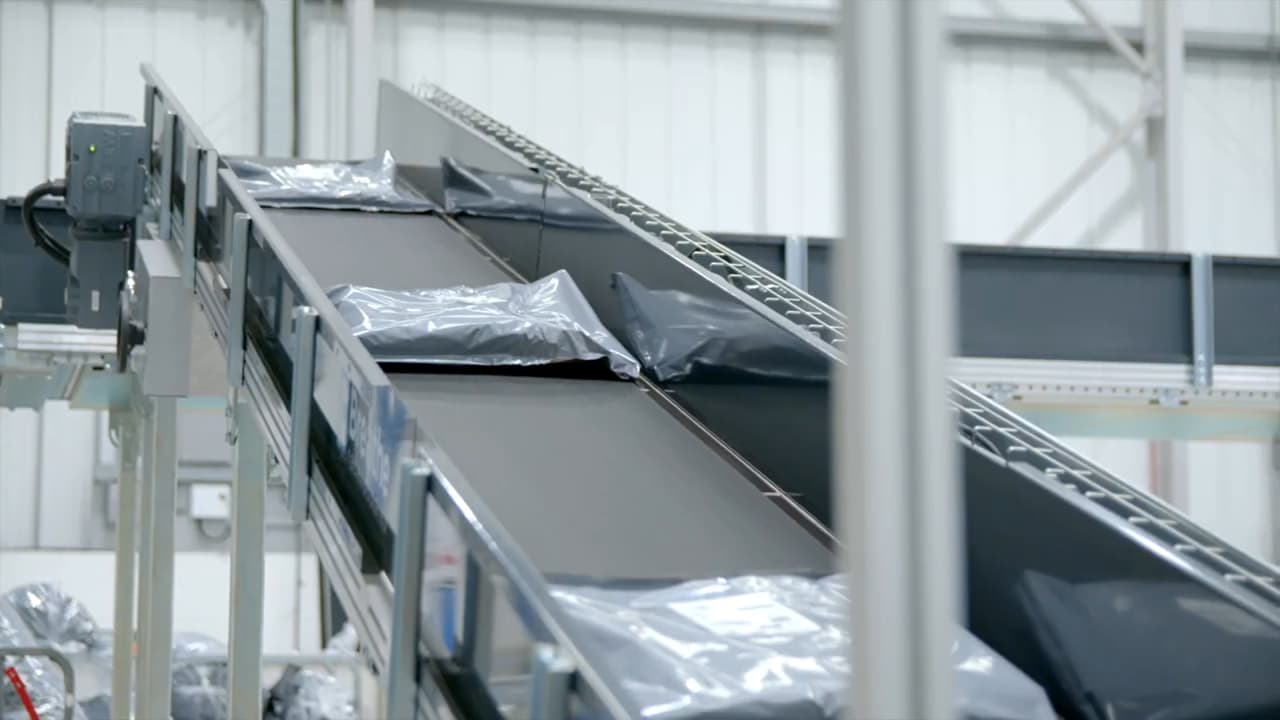
Connecting your pick area via conveyor to automated packing and labelling cuts manual touches, improves throughput, and creates a consistent, auditable pack-out process. These systems integrate directly with existing WES and WMS software.
Robotic sortation
Libiao’s T-Sort and 3D-Sort platforms can move 1,000 units per hour within a 20m x 20m footprint, highly flexible, modular, and designed to scale without locking you into a single configuration. Breathe is an official UK and EU partner and handles the full integration.
Robotics and goods movement
From autonomous mobile robots (AMRs) to AutoStore and goods-to-person systems, robotics are increasingly viable across UK warehouse operations. As integrators, Breathe is already deploying these in real-world fulfilment environments.
“The goal is always the same: the right-sized investment for where your business is now, that lays the foundations for what comes next. Automation is a roadmap, not a one-off project.”
Breathe Technologies